FTL vs. LTL Transport: What's the Difference and Which Should You Choose?
FTL vs. LTL Transport: What's the Difference and Which Should You Choose?
When moving freight across town or across the country, one of the first and most critical decisions you will make is choosing between Full Truckload (FTL) and Less Than Truckload (LTL) shipping.
Selecting the wrong shipping method can lead to inflated logistics costs, unexpected delivery delays, or unnecessary risk of damage to your products.
While both modes move goods from point A to point B, they operate under fundamentally different logistics frameworks. In this guide, we will break down how FTL and LTL work, compare their key differences, and help you determine which option best fits your supply chain strategy.
What Is FTL (Full Truckload)?
Full Truckload (FTL) means hiring an entire semi-trailer or box truck exclusively for your cargo.
With FTL shipping, the truck carries goods from a single shipper. The trailer is loaded at your location, sealed with a security lock, and driven directly to the destination address without intermediate stops or sorting hubs.
Core Features of FTL:
Dedicated Space: You reserve 100% of the truck’s weight and volume capacity.
Direct Point-to-Point Route: No hub transfers or additional pickups along the way.
Sealed Cargo: The truck remains sealed from origin to destination, minimizing handling.
What Is LTL (Less Than Truckload)?
Less Than Truckload (LTL)—often called Part Load—is a shared freight model designed for shipments that do not require an entire trailer.
Instead of paying for an empty truck, multiple shippers reserve space on a single vehicle and share the total transport cost. LTL shipments typically move through a hub-and-spoke network: local pickup trucks gather goods, bring them to a regional consolidation hub, and transfer them onto long-distance line-haul trucks.
Core Features of LTL:
Shared Space & Cost: You pay only for the exact weight or cubic footprint your cargo occupies.
Hub-and-Spoke System: Cargo is sorted and transferred at regional distribution terminals.
Accessorial Options: Easy access to specialized services like liftgate pickups, inside delivery, and residential drops.
4 Main Differences Explained
1. Cost & Pricing Structure
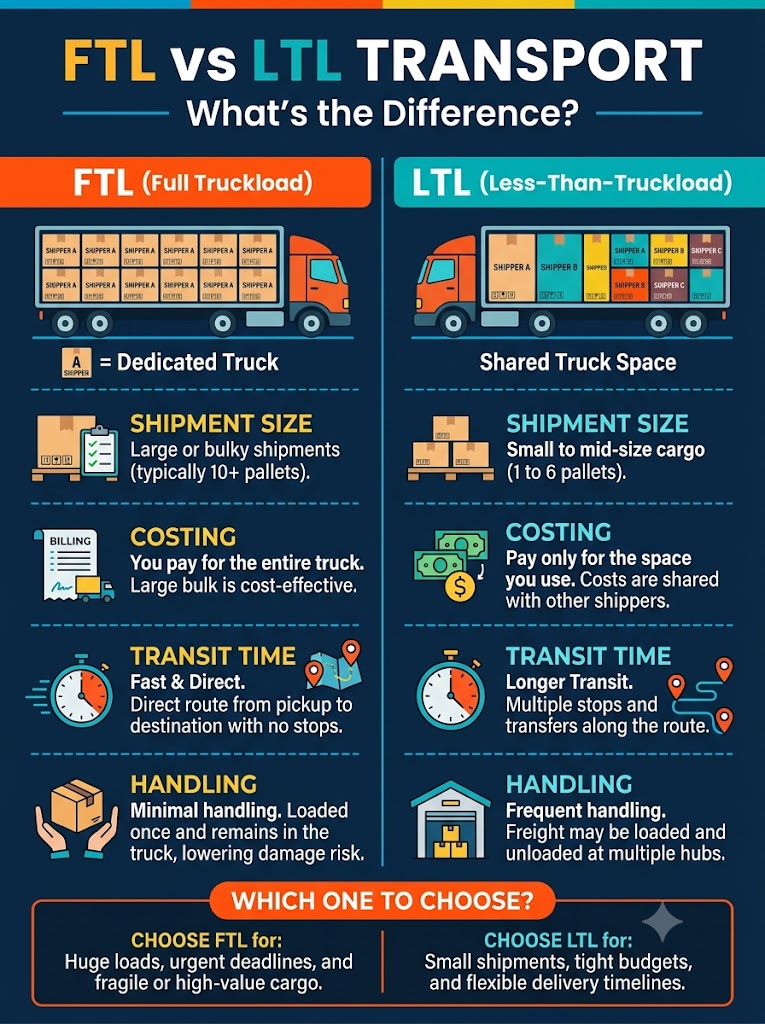
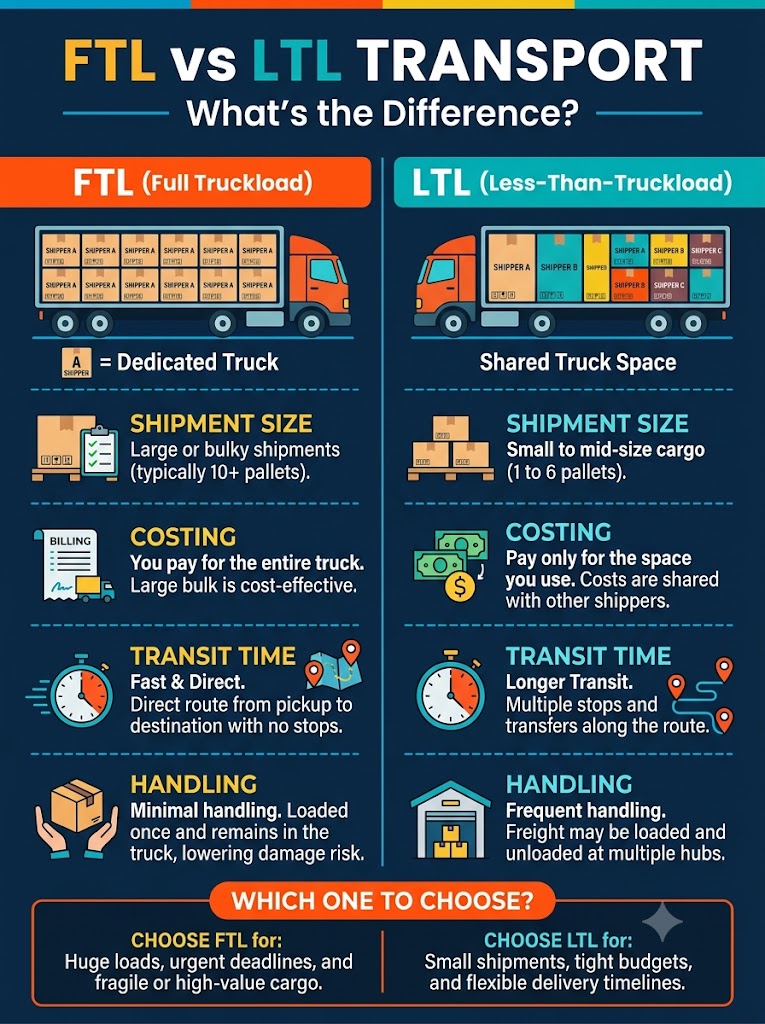
FTL Pricing: Calculated on a flat rate per mile or per lane, regardless of how full the truck actually is. If you ship 15 pallets in a 26-pallet trailer, you still pay for the entire truck.
LTL Pricing: Calculated based on cargo weight, dimensions (cubic volume), distance, and freight classification. This makes LTL vastly more economical for smaller freight volumes.
2. Transit Time & Reliability
FTL Speed: Once loaded, the driver heads straight to the destination. Transit time is constrained only by distance and legal driver hours-of-service regulations.
LTL Speed: Goods pass through multi-stop consolidation terminals. Because driver routes involve multiple pickups and drop-offs, LTL transit usually takes 1 to 3 days longer than FTL over the same distance.
3. Risk of Damage & Risk Profile
FTL Risk: Very low risk. Cargo is loaded at your facility, secured, and untouched until arrival.
LTL Risk: Moderate risk. Cargo is moved on and off forklifts at consolidation terminals. Proper packaging, palletizing, and stretch-wrapping are critical for LTL freight.
4. Tracking and Visibility
FTL Visibility: Simple point-to-point GPS tracking on the vehicle.
LTL Visibility: Tracked via Lorry Receipt (LR) numbers or PRO tracking numbers as the cargo gets scanned at each hub terminal.
When to Choose FTL Shipping
FTL is the ideal logistics choice when:
You Have Large Shipments: Your cargo fills 10 or more pallets or exceeds 10,000 lbs (4,500 kg).
Time Is Critical: You have tight delivery deadlines, strict customer appointment windows, or perishable goods.
Cargo Is High-Value or Fragile: Sensitive electronics, high-value industrial goods, or delicate materials benefit from zero intermediate handling.
You Need Hazardous Materials Handling: Certain specialized or hazardous goods require dedicated transport compliance.
When to Choose LTL Shipping
LTL is the smart choice when:
You Have Small to Mid-Sized Cargo: Your shipment is between 1 and 6 pallets and doesn't warrant renting a full truck.
You Are Operating on a Budget: Sharing freight costs across multiple shippers keeps your unit margins healthy.
Your Delivery Windows Are Flexible: You can accommodate a 24- to 48-hour transit buffer without affecting operations.
You Ship Frequent, Smaller Batches: Instead of waiting weeks to accumulate full truckloads, you ship smaller quantities as goods are produced (Just-In-Time delivery).
Simple Decision Framework
Ask yourself these three quick questions to decide:
Does my cargo take up more than half a truck trailer?
Yes → Choose FTL
No → Choose LTL
Is strict, same-day or next-day direct arrival required?
Yes → Choose FTL
No → Choose LTL
Are the goods easily damaged by forklift re-handling?
Yes → Choose FTL (or invest in heavy crating for LTL)
No → Choose LTL
MoveABox Team
Expert team at MoveABox dedicated to making your relocation experience smooth and stress-free. We share professional insights, tips, and best practices from years of moving expertise.