What Is an E-Way Bill for Household Goods?
What Is an E-Way Bill for Household Goods?
If you've ever planned an intercity move or hired professional packers and movers, you might have heard them mention an E-Way Bill. It sounds like a complex legal document meant for major factories and shipping companies—so why is it coming up for your home relocation?Let's break down what an E-Way Bill is, whether it applies to your personal household items, and what you actually need to worry about when shifting homes.
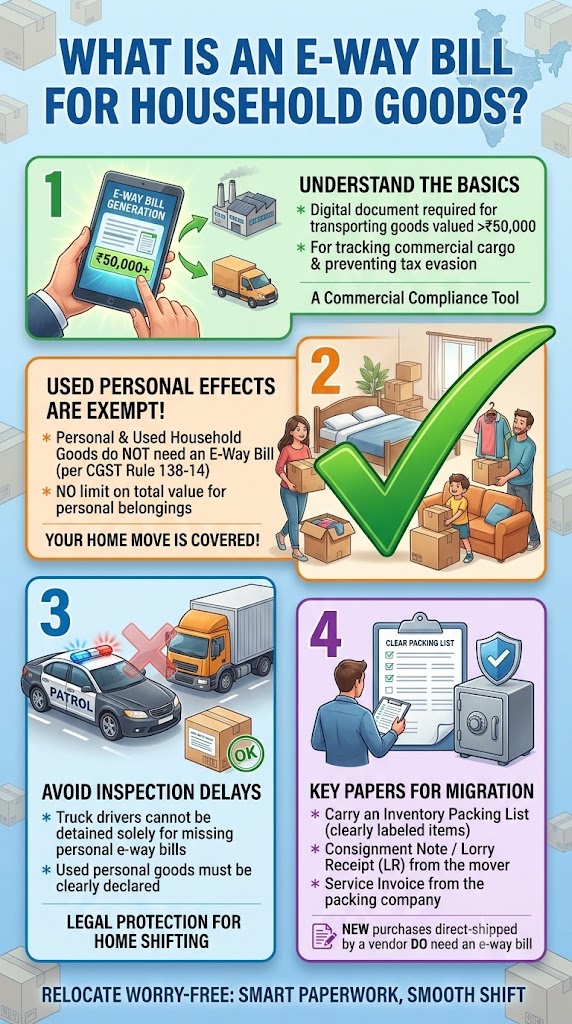
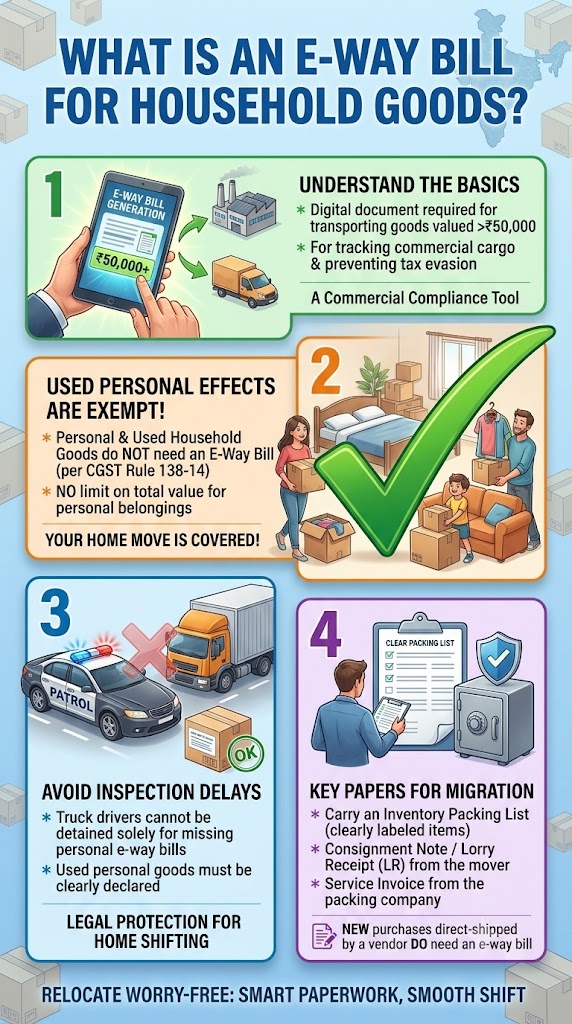
What Exactly Is an E-Way Bill? Under India’s GST (Goods and Services Tax) framework, an E-Way Bill (Electronic Way Bill) is a digital document generated on the central GST portal. It is generally required whenever goods valued over ₹50,000 are being transported in a vehicle from one place to another—whether interstate or intrastate.
The main purpose of the E-Way Bill is to track the movement of commercial cargo and prevent tax evasion.
Do You Need an E-Way Bill for Moving Household Goods? Here is the big surprise: In most cases, NO!
According to Rule 138 of the CGST Rules (specifically the exemption list under Sub-rule 14), "used personal and household effects" are explicitly EXEMPT from E-Way Bill requirements.
This means that if you are simply moving your used TV, bed, sofa, clothes, and kitchen appliances from your old home to your new house:
You do not need to generate an E-Way Bill, regardless of how much your total furniture is worth.
Transport officials cannot detain a moving truck solely for the absence of an E-Way Bill if it is carrying personal household belongings.
When MIGHT an E-Way Bill or GST Document Be Needed? While your used personal belongings don't require an E-Way Bill, there are a few specific scenarios where paperwork comes into play:
New Purchases Shipped Directly: If you bought a brand-new ₹70,000 refrigerator or modular sofa set and the showroom is delivering it directly to your new house, the seller/vendor must generate an E-Way Bill for that brand-new item.
Moving Company Invoices: Your packers and movers will issue a Consignment Note / Lorry Receipt (LR) and a tax invoice for their shifting services. While you don't need an E-Way Bill for your furniture, the driver should carry the LR and inventory list during transit to avoid highway inspection delays.
The Takeaway for Home Movers If a mover tries to charge you extra fees for "generating a personal household E-Way Bill," be aware that used personal belongings are legally exempt! All you need is a clear inventory packing list and a consignment note from your moving partner to enjoy a hassle-free shift.
MoveABox Team
Expert team at MoveABox dedicated to making your relocation experience smooth and stress-free. We share professional insights, tips, and best practices from years of moving expertise.