What Is 3PL Warehousing?
What Is 3PL Warehousing?
A Complete Guide for Growing BusinessesAs your business grows, so does the complexity of managing physical inventory. What starts as a few boxes in a garage or small office can quickly turn into a logistical headache of overcrowded storage spaces, mispacked orders, and delayed shipments.
This is where 3PL (Third-Party Logistics) Warehousing becomes a game-changer.
Outsourcing your warehousing and order fulfillment to a specialized logistics partner allows you to scale operations rapidly without committing to expensive commercial leases, equipment, or warehouse staff.
In this guide, we will break down what 3PL warehousing is, how it works, the core services offered, and how to decide whether it is the right strategic move for your company.
What Is 3PL Warehousing?
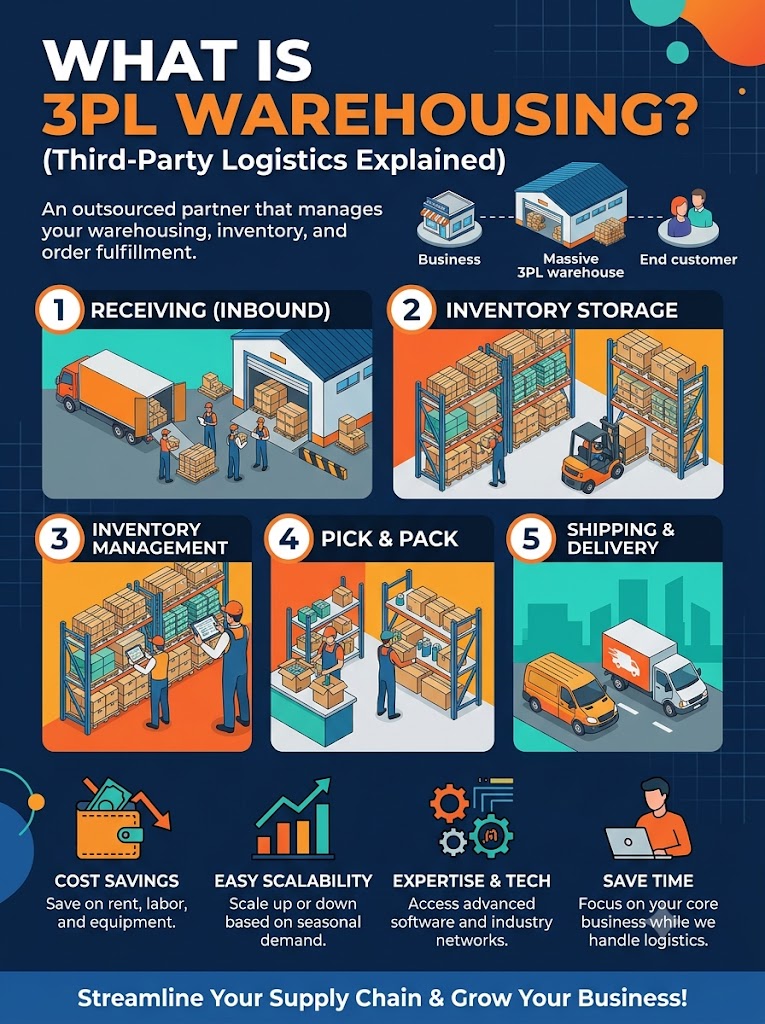
3PL warehousing refers to outsourcing your inventory storage, management, and order fulfillment operations to an external logistics service provider.
Instead of leasing and running your own warehouse facility, you ship your inventory to a 3PL provider's distribution center. When a customer places an order on your sales platform (such as Shopify, Amazon, or a custom B2B portal), the 3PL automatically receives the order, picks and packs the items, and ships them directly to the end customer.
How 3PL Differs From Other Logistics Models
To understand 3PL better, it helps to see where it fits among logistics options:
1PL (First-Party Logistics): You manage all storage and shipping in-house using your own vehicles and staff.
2PL (Second-Party Logistics): You manage storage, but hire an external carrier (like FedEx or DHL) solely for transportation.
3PL (Third-Party Logistics): You outsource both storage and fulfillment operations to a single specialized partner.
4PL (Fourth-Party Logistics): A master consultant manages your entire supply chain, overseeing multiple 3PLs, carriers, and suppliers on your behalf.
Core Services Offered by 3PL Warehouses
Modern 3PL facilities offer far more than just floor space for boxes. They provide end-to-end operational support, including:
1. Receiving and Inbound Logistics
When your goods arrive from manufacturers or suppliers, the 3PL inspects the shipment, verifies quantities against your purchase order, scans SKUs into their Warehouse Management System (WMS), and stores them in assigned locations.
2. Inventory Management & Storage
Your inventory is stored securely in climate-controlled, racked, or bulk storage zones depending on your product requirements. Real-time inventory tracking allows you to monitor stock levels remotely and set reorder alerts.
3. Pick and Pack Fulfillment
When an order is placed, automated systems direct warehouse personnel (or robots) to retrieve the correct SKUs from the shelves. Items are brought to a packing station where they are checked for accuracy, packaged in appropriate containers, and labeled for dispatch.
4. Kitting and Assembly
If you sell product bundles, subscription boxes, or items requiring customized packaging, many 3PLs offer kitting services—assembling individual items into a single ready-to-ship unit before an order is placed.
5. Shipping and Carrier Rate Negotiation
Because 3PLs move high volumes of freight across all client accounts, they negotiate heavily discounted shipping rates with national and international carriers (e.g., UPS, FedEx, DHL, local freight carriers). These savings are frequently passed on to you.
6. Reverse Logistics (Returns Management)
Handling returned items efficiently is critical for maintaining customer satisfaction. A 3PL receives returned goods, inspects them for damage, restocks sellable items into active inventory, and processes disposals or repairs according to your guidelines.
5 Signs It Is Time to Switch to a 3PL
If you are unsure whether your business is ready for third-party warehousing, look out for these indicators:
Fulfillment Is Distracting From Growth: You spend more time packing boxes and printing shipping labels than focusing on product development, marketing, and sales.
You Are Running Out of Storage Space: Stock is spilling over into hallways, offices, or extra storage units, creating disorganization and inventory errors.
Seasonal Volume Spikes Break Your System: During peak sales periods (like Black Friday or holiday sales), order processing slows down, leading to late deliveries and customer complaints.
Shipping Costs Are Eating Your Margins: High regional shipping rates are making it hard to offer competitive shipping costs to customers.
You Want to Expand Geographically: Shipping everything from a single central location causes long delivery times and high costs for customers located farther away.
Key Benefits of 3PL Warehousing
Cost Savings: Eliminates long-term lease commitments, warehouse utility bills, equipment maintenance, and fixed labor overhead.
Faster Delivery Times: Many 3PLs operate network hubs across multiple regions, allowing you to store inventory closer to your primary customer centers for faster, cheaper ground shipping.
Industry Expertise: You gain access to seasoned logistics professionals who specialize in slotting optimization, routing efficiency, and inventory accuracy.
Seamless E-Commerce Integration: Modern 3PLs plug directly into storefront platforms like Shopify, WooCommerce, Amazon, and Magento for real-time order syncing.
How to Choose the Right 3PL Partner
When evaluating prospective 3PL providers, ask the following questions during your vetting process:
Platform Compatibility: Does their Warehouse Management System (WMS) integrate natively with your sales channels?
Location Network: Do they have fulfillment centers near your target audience or primary import ports?
Specialization: Do they have experience handling your specific product type (e.g., cold storage, fragile goods, hazardous materials, apparel)?
Pricing Transparency: Is their fee structure clear? (Look for receiving fees, storage fees per pallet/shelf, pick-and-pack fees, and shipping rates).
Service Level Agreements (SLAs): What are their guaranteed order cutoff times, shipping accuracy rates, and error resolution timelines?
MoveABox Team
Expert team at MoveABox dedicated to making your relocation experience smooth and stress-free. We share professional insights, tips, and best practices from years of moving expertise.