How to Courier a Parcel Internationally from India
How to Courier a Parcel Internationally from India: Step-by-Step Guide
Sending a parcel overseas—whether it's homemade snacks to family in the US, academic transcripts to a university in the UK, or personal belongings to a friend in Dubai—can feel overwhelming due to customs regulations, paperwork, and strict courier guidelines.
However, with streamlined digital customs processing in India and clear rules set by Indian Customs (CBIC), shipping internationally is simpler than ever when you follow the right steps.
Here is a clear, step-by-step guide on how to send an international parcel from India smoothly and without delays.
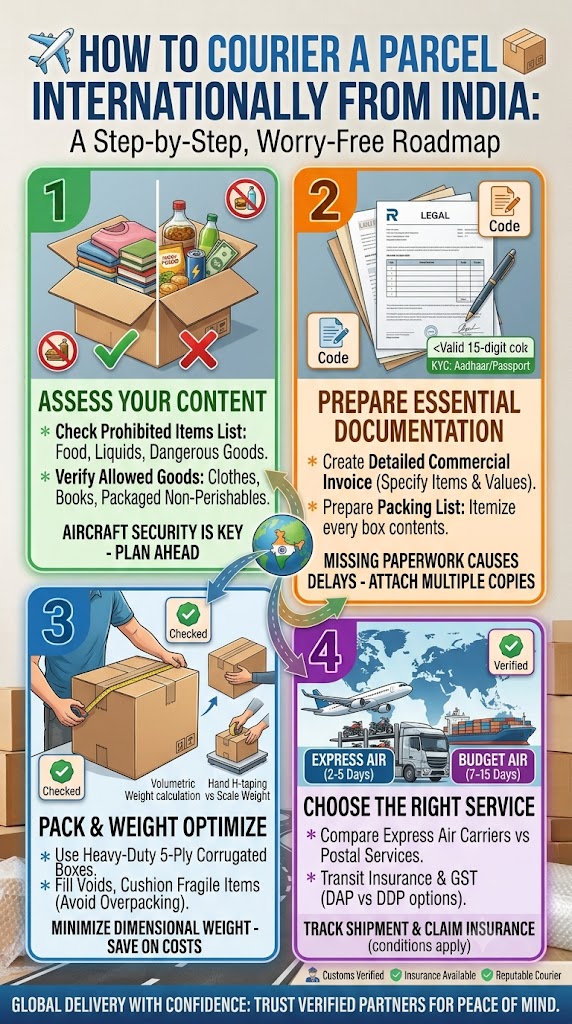
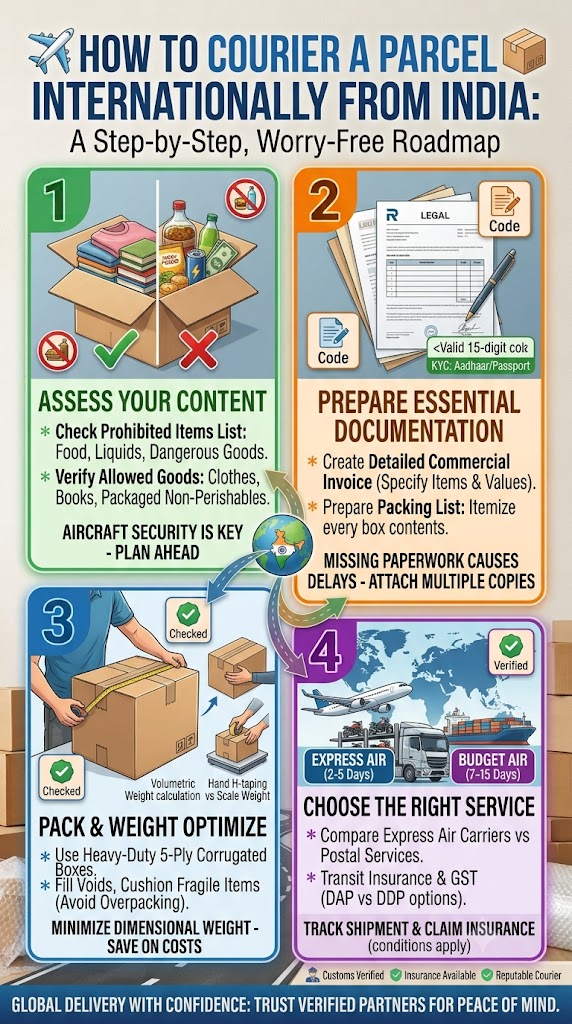
1. Choose the Right Courier Service
Your choice of shipping partner depends on your budget, urgency, and the nature of the items:
India Post (Speed Post International / EMS):
Best for: Budget-friendly shipping, books, non-urgent documents, and low-value personal gifts.
Pros: Highly economical and reaches over 200 countries via foreign post offices.
Cons: Longer transit times (7–15 days) and basic tracking updates compared to private carriers.
International Express Couriers (DHL, FedEx, UPS, Aramex):
Best for: Time-sensitive documents, high-value goods, medicine shipments, and door-to-door tracking.
Pros: Rapid delivery (2–5 days), end-to-end tracking, and dedicated customs handling.
Cons: Higher freight charges.
Specialized Aggregators (AICS, Atlantic, Garudavega, Shoppre):
Best for: Homemade foods, pickles, student luggage, and excess baggage. They aggregate shipments and offer doorstep pickup with custom packing support.
2. Mandatory Documents Required (Sender & Receiver)
Indian Customs mandates strict KYC verification for all outgoing international parcels. Make sure you keep self-attested copies of these documents ready:
Sender’s KYC (ID & Address Proof):
Aadhaar Card, Passport, or Voter ID.
PAN Card (often mandatory for value verification).
Receiver’s Complete Details:
Full Name, Street Address, City, State, Postal Code, Country, Mobile Number, and Email ID.
Proforma Invoice / Packing List:
A detailed itemized list showing description, quantity, weight, and individual value of each item in Indian Rupees (INR) or destination currency.
Sender's Declaration Form:
A signed declaration stating that the package contains non-commercial personal items/gifts and contains no banned or illegal substances.
3. Special Cases: Foods, Medicines, and Student Belongings
Certain categories require specialized additional documentation to clear Indian and destination customs:
Homemade Foods & Pickles: Must be commercially sealed or packed professionally to prevent leaks. Ingredients lists may be requested by destination customs (e.g., US FDA guidelines).
Medicines: Require a valid doctor’s prescription, pharmacy purchase invoice, and sender/receiver ID proof.
Student Luggage: A copy of the student’s university admission letter, passport, and student visa copy can help classify the shipment as personal effects and avoid commercial import duties.
4. Prohibited & Restricted Items List
To avoid parcel seizure or penalties, never pack the following items:
Flammable items & Aerosols: Perfumes, deodorants, nail polish, sanitizers, and lighter fluid.
Perishables: Raw meat, dairy products, or non-sealed homecooked items that spoil quickly.
Batteries: Loose lithium-ion batteries or high-capacity power banks.
Cash & Precious Metals: Currency, raw gold, bullion, and real jewelry.
Controlled Substances: Unprescribed drugs, liquid chemicals, and weapons.
5. Packaging Guidelines for Overseas Transit
International cargo undergoes multiple handlings, air transit, and customs inspections.
Use Heavy-Duty Corrugated Boxes: Opt for double-walled or triple-walled cardboard boxes. Avoid flimsy used boxes.
Cushion Thoroughly: Wrap fragile items individually in bubble wrap, filling empty spaces with packing peanuts or crumpled paper.
Seal with H-Taping Method: Apply heavy-duty brown packing tape along all seams and flaps in an "H" pattern.
Do Not Seal Before Customs Check (if requested): Some local courier agents need to physically inspect the contents against your packing list before final sealing.
6. Step-by-Step Dispatch ProcessWeigh & Calculate Freight:
Weigh your box after packing. Remember that international couriers charge based on Volumetric Weight ($\frac{\text{Length} \times \text{Width} \times \text{Height (cm)}}{5000}$) or Actual Weight—whichever is higher.
Book Pickup or Drop-Off: Schedule a doorstep pickup or visit your local branch / post office.
Upload KYC & Submit Invoice: Fill in the digital Air Waybill (AWB) and hand over the self-attested documents.
Track Your Shipment: Use your AWB / Tracking number on the courier portal to monitor export clearance at Indian airport hubs and import clearance in the destination country.
MoveABox Team
Expert team at MoveABox dedicated to making your relocation experience smooth and stress-free. We share professional insights, tips, and best practices from years of moving expertise.