Demystifying Part Load Transport: What It Is and When to Use It
Demystifying Part Load Transport: What It Is and When to Use It
Learn what part load transport (PTL/LTL) is, how it works, and when your business should use it to reduce shipping costs and optimize logistics.
Target Audience: Logistics managers, e-commerce business owners, supply chain leads, and small-to-medium enterprise (SME) owners.
Primary Keywords: Part Load Transport, Partial Truckload, PTL shipping, Less Than Truckload, freight optimization
Demystifying Part Load Transport: What It Is and When You Should Use It
In the fast-paced world of logistics, choosing the right freight shipping strategy can directly impact your operational costs and customer satisfaction. While most businesses are familiar with Full Truckload (FTL) for massive shipments and standard Express Courier for small parcels, many struggle with shipments that sit right in the middle.
This is where Part Load Transport (often referred to as Partial Truckload or PTL/LTL) comes into play.
In this guide, we'll cover what part load transport is, how it operates, how it compares to other shipping options, and when you should leverage it to optimize your shipping budget.
What is Part Load Transport?
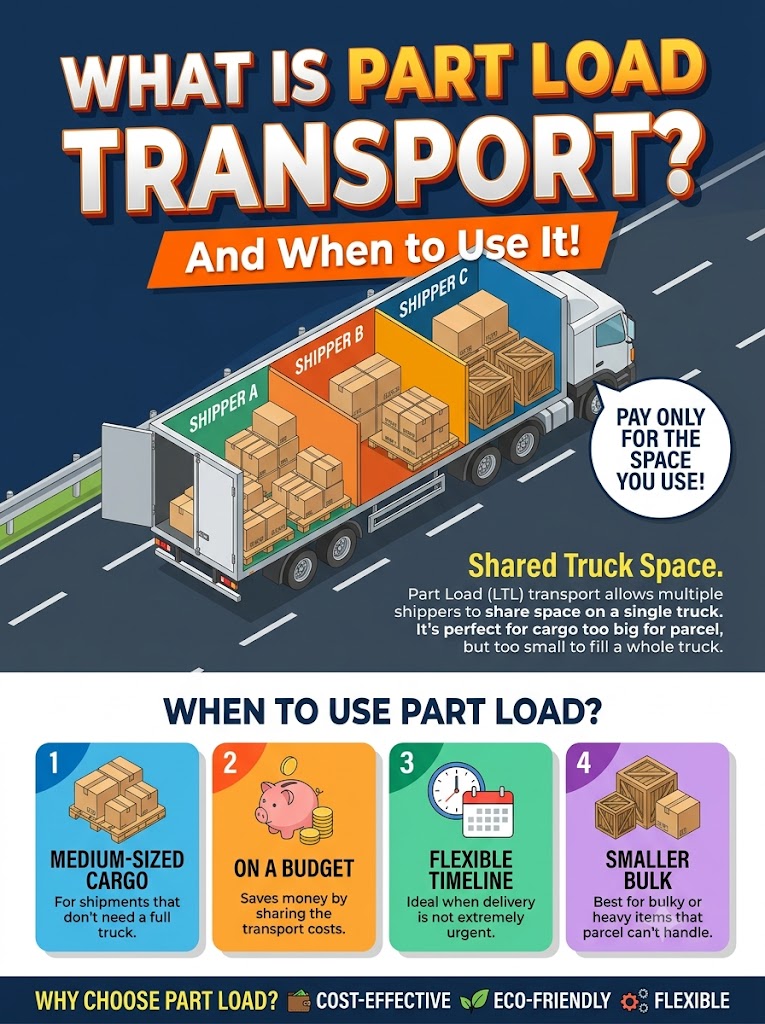
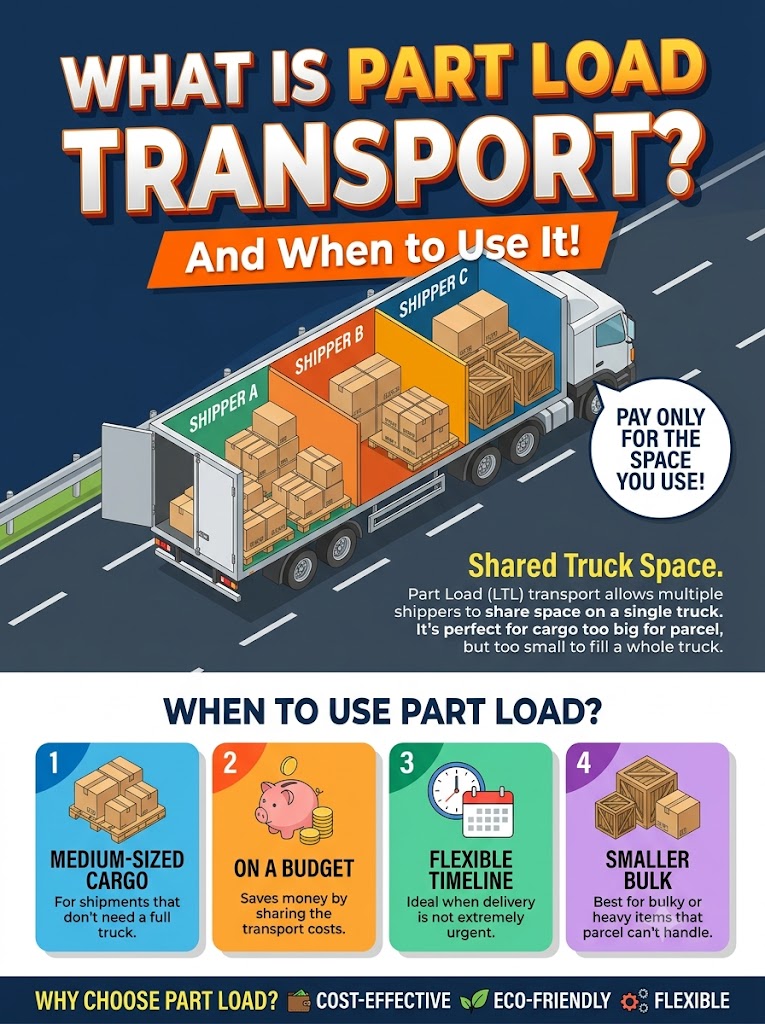
Part Load Transport is a freight delivery method where your goods occupy only a portion of a truck's total capacity rather than the entire vehicle.
Instead of paying for an entire 32-foot container or trailer, you only pay for the specific space (volume or weight) your cargo uses. The logistics provider combines your goods with cargo from other businesses traveling along similar routes.
Analogy: Think of Part Load Transport like a rideshare service for freight. Just like pooling a ride reduces individual fare costs, sharing trailer space reduces freight charges across multiple shippers.
How Part Load Transport Works: Step-by-Step
Booking & LR Generation: You book your cargo space and receive a Lorry Receipt (LR) / Consignment Note for tracking.
Pickup & Consolidation: Local pickup vehicles collect cargo from multiple shippers and take it to a regional logistics hub.
Long-Haul Transit: The regional hub consolidates cargo bound for the same general region into a single full truck for long-distance transport.
De-consolidation & Final Delivery: At the destination hub, cargo is sorted onto smaller local trucks for final drop-off to recipients.
5 Key Scenarios: When Should You Use Part Load Transport?
1. Your Shipment Size is "In-Between"
If your freight exceeds normal courier weight limits (typically over 100 kg or occupying 1 to 6 pallets) but isn't large enough to justify paying for an entire 32-foot trailer, PTL is the ideal choice.
2. Cost Reduction is Your Top Priority
Paying for empty space in a truck directly eats into profit margins. PTL allows you to share fuel, toll, and driver overhead expenses with other shippers, significantly reducing per-unit transport costs.
3. Your Delivery Timelines are Flexible
Because part load shipments involve consolidation at sorting hubs, transit times may take 1–2 days longer than a direct dedicated truck. If your cargo is not highly time-critical or perishable, PTL yields maximum ROI.
4. You Want to Reduce Carbon Footprint
Empty or half-filled trucks on the road contribute unnecessarily to global carbon emissions. By consolidating loads, PTL maximizes vehicular efficiency and supports greener, more sustainable supply chains.
5. You Manage Just-In-Time (JIT) Inventory For small-to-medium enterprises (SMEs) and e-commerce sellers, waiting to accumulate enough stock to fill a full truck can cause inventory shortages. PTL lets you ship stock in smaller, regular batches to keep fulfillment centers supplied.
Best Practices for Successful Part Load Shipping
Invest in Secure Packaging: Because goods undergo handling during consolidation, use sturdy palletizing, shrink wrapping, and edge protectors.
Provide Accurate Weight & Dimensions: Discrepancies between declared and actual measurements can result in re-weighing fees or delivery delays.
Track via LR Number: Keep your Lorry Receipt (LR) number handy to monitor real-time updates through your transporter’s online tracking portal.
MoveABox Team
Expert team at MoveABox dedicated to making your relocation experience smooth and stress-free. We share professional insights, tips, and best practices from years of moving expertise.